Little Soldier's Story of the Battle
MORNING OF JUNE 25 I got up and went after [the] horses and [came] back to water [them]. I brought one horse back and kept him in camp. [I then] had breakfast, took bow and arrows and went down to [the] river to play with [the] boys. While we were there, I heard a camp crier riding along the camp on a swift horse, calling. We knew something must be up, so [we] came back to [the] tents and our people told us [that] two Indians already [had been] killed. A young boy, Deeds, and Hona [were] shot at by soldiers. Both [were] shot at. Little Bear [was also] wounded, but got away. His horse was killed and he was shot in [the] leg. (Frank Zahn explains that when Little Bear's horse was shot and he was wounded so that he could not continue in the fight, that the Indians regarded and spoke of such a man as [being] dead. Little Bear was [the] father of Deeds and Hona and Mary Crawler.) [Note: Drags The Rope said Brown Back was Deed's older brother, not his father.] |
|||||||||||||||||||||||||||||||
THE BATTLE BEGINS We all looked east at [the] bluffs and saw three bodies of soldiers. [The] south body moved first and went south. Then the middle body [moved] and crossed. Everybody was running for horses. [I] saw Reno's men crossing the river. I saw two divisions of Reno's men coming, each carrying a flag. The soldiers who went north went behind the ridges. [They] rode bay and gray horses. I got on my horse and [so did] other warriors, and [Reno's] men shot into [the] Hunkpapa camp. Hona is [a] brother of Deeds. [The] boy was over one mile from [the] camps when [he was] killed. [The] women took [the] children. [The] older warriors were out hunting buffalo, [and] for that reason [only] boys [from] 13 to 18 [years old] did the fighting. Old men sang death songs for [the] warriors. Sweethearts, young Indian mothers, and children [were] all wailing and crying. First the Indians rode to [the] soldiers holding horses and drove them away to cover. Then [the] warriors attacked the soldiers on foot. [These] soldiers lay down, and others got on [their] knees and others stood. Warriors rode into them. [The] bullets came like hail when [the] fire first started. [The] bullets sounded like hail on [the] tepees and tree tops. [I] could see [the] bullets hit dirt. I was armed with my bow and arrows. Indian horses were brought in and mounted by warriors and squaws with hordes. Old decrepit men and women hurried on [and] walked ahead of squaws and children who rode behind them to protect them. Women would call to children, and children would recognize [their] mothers' voices. As [the] warriors rode on, the soldiers ran and mounted any horse and stopped fighting. Hawk Man said, "Charge," and rode out in front at the soldiers alone the first time. So Hawk Man rode out in front and no [one] followed the first time. [The] second time [he] led. Where [the] soldiers plunged into [the] river it was like steep sides. Then from [the] east bank a body of soldiers [under Custer] charged down upon us. (There were other Indian camps up the river who did not know of the battle.) I saw Two Bull's horse killed in retreat. During all this time a single soldier came back who they killed. [The] warriors followed Reno's men to [the] river, crossed [the] river and chased [the] soldiers clear up on top of [the] bluff. Before [the] Indians got to top we heard a commotion down the river, so we gave up the chase after Reno and turned back north and rode down the river. CUSTER Followed by clouds of dust, [the] soldiers showed themselves about [blank] miles away. Other Indians who were already downriver saw Custer's dust and crossed the river. Custer's men dismounted. [Their] horses got away and ran for [the] river. Custer's men were all scattered out. [The] soldiers lined up on a ridge; then they sang. [The] Indians scared [the] horses [and] ioo [horses] were killed before [the] soldiers retreated on foot.' [The] horses got away and ran to the river. [The] Indians were on [the] east side of [the] soldiers and all around them. The soldiers wore campaign hats; coats light blue; and trousers of a lighter blue, with [a] yellow strip; yellow spears (guidons?) and horse towels. [The] soldiers wore black boots with flat heels and spurs with rowels. None of Custer's soldiers got across the river to the west side of the Little Big Horn. [The discharge of] black powder made the whole battlefield dark and gray. It was so dark that we could see the flash of the rifles. No one knew it was Custer until afterwards. Some of Custer's men got into draws and coulees and fought there. From time to time Custer moved [his] flag from hill to hill. [The] Cheyennes and Sioux were soon all mixed-in together in the fight. [The] Indians took after a man who was running back. Lots of horses [were] wounded. Did any of [the] soldiers kill themselves? I think so. [The] Indians plundered [the] soldiers. [The] Indians saw dozens of whiskey bottles on [the] ridge above the river. Some Indians could see soldiers a long ways away, passing the cup (whiskey). [The] Indians got [the] rifles of [the] soldiers as soon as they killed a soldier. Down in Reno's fight [the] Indians [got] ammunition, and on Custer field grabbed [the] rifles. [The] Indians would not scalp soldiers with short hair. No glory to scalp anyone with short hair, [says] Frank Zahn. [The] Indians surrounded Reno on the hill, and next morning fought again. The Indians left Reno Hill the second day around 2 or 3 P.M. Custer part of fight lasted about an hour. Less than 1,000 warriors altogether fought against Custer. Sixty-four Indians were killed altogether on [the] battleground, and several died later. [The] Indians captured or found 368 rifles. [The] women and children used the cavalry saddles on [the] retreat after they left the camps for the southwest.
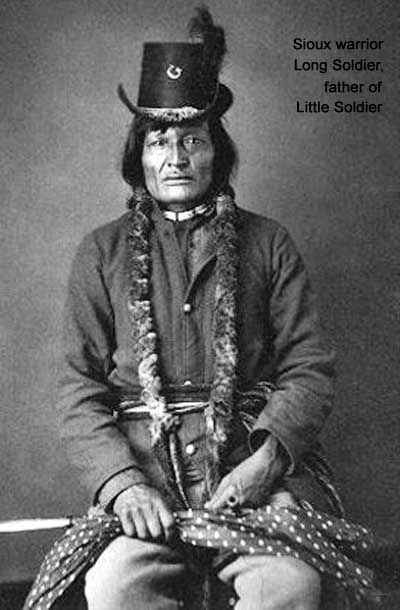
Great warriors: Crazy Horse was the greatest fighter, said Little Soldier. The greatest fighter in the whole battle was Crazy Horse. Little Soldier said that Sitting Bull, when breaking camp on the Rosebud where a group of young men were racing horses ... [warned,] "You are racing your horses now, but don't race them too hard and play them out, for you all are going to have a big fight soon." [The] Indians think of Sitting Bull as a great seer [who was] respected at that time. Little Soldier's father was Long Soldier. Indian Views of the Custer Fight: A Source Book by Richard G. Hardorff, The Arthur Clark Co. Spokane, WA 2004, p 173 - 178
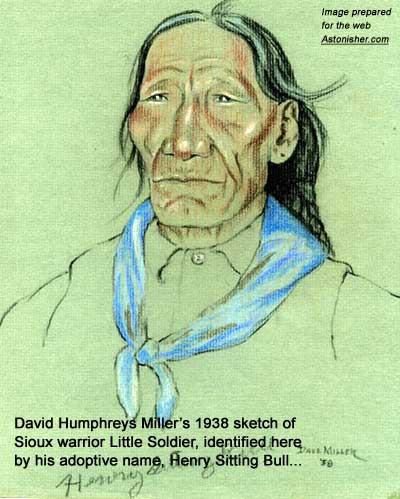
The son of Long Soldier, Little Soldier was also a stepson of Sitting Bull's, as a result of his mother Four Robes Woman's remarrage in 1869 and Sitting Bull's subsequent adoption of Little Soldier. Sitting Bull's many adopted sons also included the Minneconjou brothers, One Bull and Lazy White Bull.
© Copyright 1973 - 2020 by Bruce Brown and BF Communications Inc. Astonisher, Astonisher.com, Conversations With Crazy Horse, 100 Voices, Who Killed Custer? and The Winter Count of Crazy Horse's Life are trademarks of BF Communications Inc. BF Communications Inc. Website by Running Dog |
|
||||||||||||||||||||||||||||||






 Little Soldier followed