
Charles Varnum's Story of the Battle
A 7th Cavalry survivor's account of the Battle of the Little Bighorn
|
From the Lowell Weekly Journal, August 1876.
|
Note |
FIGHTING THE INDIANS
Camp on the Yellowstone, July 4, 1876.
Dear Father and Mother:
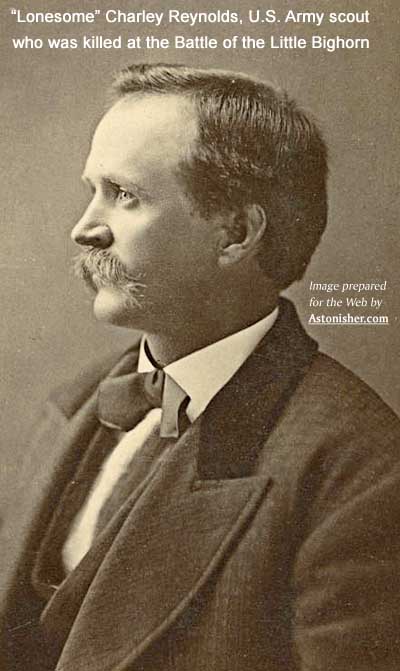
 Having an opportunity of sending off a letter this evening, I will try and give you an account of our operations since I wrote you last. On the 22d of June General Custer took the entire regiment, numbering about 605 strong, with my squad of about thirty-six scouts and guides, interpreters, etc., and started up the Rosebud river after the. Indians, whose trail was discovered by Major Reno. We made about twelve miles the first day and thirty-two or three on the second, and early on the morning of the third day we got on a very heavy trail going up the Rosebud. About ten miles from camp we found a circle surrounded by a brush fence arranged for a sun-dance, a description of which I have given you before, for making warriors. We found a stick with a fresh scalp attached and the trail of two or three Indians, evidently made that morning. We marched twenty miles, and then I was sent back six to examine a creek to see if any Indians had left the trail, and on my return we started again and made eight miles more, and camped in an Indian camp about two days old. The signs indicated an immense force, and we were in a hurry to take them by surprise. Custer came over to see the scouts. Six Crows with us, who knew the country well, said that the trail from here led on towards the Little Horn, a fork of the Bighorn, and they wanted to go ahead about twenty miles to a high bluff from which the valley of the Little Horn could be seen. Custer wanted some intelligent white man to go ahead with them to send him information. I took the six Crows, five Rees, and a white man, who was an old frontiersman, and we marched all night, making about sixty miles. I had rode without rest or any sleep for thirty-six hours. Custer said he would start at 11 p. m., and come somewhere near us by morning. At 2:30 o'clock we reached the hill, and lay there in scrub bushes until daybreak, when we discovered the smoke of a village, and by 5 a. m., I started the Rees back with a dispatch to General Custer. The Crows said there were about two or three thousand ponies on the plain twelve miles off, but I could not see them, as their eyes were better than mine. Custer had come ahead, and we could see his camp about eight miles off. He got my dispatch at 8 a. m., and started again and came to the hill. In the meantime two Sioux were seen going in the direction of Custer's column. Charley Reynolds, myself, the Crow interpreter and two Crows started out to kill them, and prevent Custer being discovered. We failed to do it, however, and when Custer came up we informed him of the state of affairs, and he concluded, as we were discovered, to hurry up and strike them as soon as possible. [Note: He Dog said that a Sioux named Fast Horn was one of the Indians Varnum saw that morning.] Having an opportunity of sending off a letter this evening, I will try and give you an account of our operations since I wrote you last. On the 22d of June General Custer took the entire regiment, numbering about 605 strong, with my squad of about thirty-six scouts and guides, interpreters, etc., and started up the Rosebud river after the. Indians, whose trail was discovered by Major Reno. We made about twelve miles the first day and thirty-two or three on the second, and early on the morning of the third day we got on a very heavy trail going up the Rosebud. About ten miles from camp we found a circle surrounded by a brush fence arranged for a sun-dance, a description of which I have given you before, for making warriors. We found a stick with a fresh scalp attached and the trail of two or three Indians, evidently made that morning. We marched twenty miles, and then I was sent back six to examine a creek to see if any Indians had left the trail, and on my return we started again and made eight miles more, and camped in an Indian camp about two days old. The signs indicated an immense force, and we were in a hurry to take them by surprise. Custer came over to see the scouts. Six Crows with us, who knew the country well, said that the trail from here led on towards the Little Horn, a fork of the Bighorn, and they wanted to go ahead about twenty miles to a high bluff from which the valley of the Little Horn could be seen. Custer wanted some intelligent white man to go ahead with them to send him information. I took the six Crows, five Rees, and a white man, who was an old frontiersman, and we marched all night, making about sixty miles. I had rode without rest or any sleep for thirty-six hours. Custer said he would start at 11 p. m., and come somewhere near us by morning. At 2:30 o'clock we reached the hill, and lay there in scrub bushes until daybreak, when we discovered the smoke of a village, and by 5 a. m., I started the Rees back with a dispatch to General Custer. The Crows said there were about two or three thousand ponies on the plain twelve miles off, but I could not see them, as their eyes were better than mine. Custer had come ahead, and we could see his camp about eight miles off. He got my dispatch at 8 a. m., and started again and came to the hill. In the meantime two Sioux were seen going in the direction of Custer's column. Charley Reynolds, myself, the Crow interpreter and two Crows started out to kill them, and prevent Custer being discovered. We failed to do it, however, and when Custer came up we informed him of the state of affairs, and he concluded, as we were discovered, to hurry up and strike them as soon as possible. [Note: He Dog said that a Sioux named Fast Horn was one of the Indians Varnum saw that morning.]
 At about 2:30 we came up to the neighborhood of the camp, and three companies, A, G and M, under Major Reno, started in. I saw them going, and Lieutenant Hare, who had been ordered to report to me for duty with our scouts, went in with them. They pretended to run away and we charged up the valley, near the village, dismounted, put our horses in the timber near the stream, and fought on foot. My scouts scattered about so I had no command near me, and I reported to Captain Moylan for duty with Company A. In half an hour we were not only surrounded, but the odds against us were so fearful that we were obliged to retreat, and we returned up into the woods and started on a run for the bluff. The Indians did not press us very hard, and we knew from the fearful firing at the other end of the village that some one was getting it hot and heavy up there. On the bluff we reorganized, and found that Lieutenant McIntosh and DeRudio were gone, and Lieutenant Hodgson was killed close by. Only five men and Lieutenant Wallace came out with company G, and more than one-third of our command was gone. Just then Colonel Benteen and three companies came in from a trip they had endeavored to make to the rear of the village, and the pack-train came up with one company more. This gave us four full companies with the remains of three others and the citizen portion, numbering in all about three hundred men. We could hear heavy firing about two miles off, and knew that Custer, with the remaining five companies, was having a hard fight beyond the village. As soon as we could get into any sort of shape we started along the bluff to try and unite with Custer, and after a mile's march we could see no sign of him; while the firing was very distant. As we were encumbered with wounded and had the whole packtrain on our hands, and hundreds of Indians were turning their attention to us, we selected a good place for defence on the bluffs, and prepared to receive them. The place was well selected, while the horses were in a sort of hollow where they could be shot at from only one direction, and here the ball opened. At about 2:30 we came up to the neighborhood of the camp, and three companies, A, G and M, under Major Reno, started in. I saw them going, and Lieutenant Hare, who had been ordered to report to me for duty with our scouts, went in with them. They pretended to run away and we charged up the valley, near the village, dismounted, put our horses in the timber near the stream, and fought on foot. My scouts scattered about so I had no command near me, and I reported to Captain Moylan for duty with Company A. In half an hour we were not only surrounded, but the odds against us were so fearful that we were obliged to retreat, and we returned up into the woods and started on a run for the bluff. The Indians did not press us very hard, and we knew from the fearful firing at the other end of the village that some one was getting it hot and heavy up there. On the bluff we reorganized, and found that Lieutenant McIntosh and DeRudio were gone, and Lieutenant Hodgson was killed close by. Only five men and Lieutenant Wallace came out with company G, and more than one-third of our command was gone. Just then Colonel Benteen and three companies came in from a trip they had endeavored to make to the rear of the village, and the pack-train came up with one company more. This gave us four full companies with the remains of three others and the citizen portion, numbering in all about three hundred men. We could hear heavy firing about two miles off, and knew that Custer, with the remaining five companies, was having a hard fight beyond the village. As soon as we could get into any sort of shape we started along the bluff to try and unite with Custer, and after a mile's march we could see no sign of him; while the firing was very distant. As we were encumbered with wounded and had the whole packtrain on our hands, and hundreds of Indians were turning their attention to us, we selected a good place for defence on the bluffs, and prepared to receive them. The place was well selected, while the horses were in a sort of hollow where they could be shot at from only one direction, and here the ball opened.
We fought, God and ourselves only know how hard, until about 9 o'clock, and then the firing ceased until the first streak of daylight, when the ball opened again. We fortified as much as the four spades we had would let us, and all day long they piled lead into us at a fearful rate. The men fell fast, but young boys soon became old men, and men lay in the trench beside corpses with flies and maggots, and struck and fought like old veterans of years' standing. The hospital held about forty wounded, but was protected by the mules and horses which surrounded it, and which must be hit before the bullets could hit the men. I will not attempt to describe the horror of the situation. We had no water, and the men became furious, and detachments were sent under heavy fire to try and get some. Many were killed and wounded in that way. [Note: here is Mrs. Spotted Horn Bull's cheerful recollection of the water brigade slaughter, and here is the account of Peter Thompson, who won the Medal of Honor for valor on the water detail.] The horses suffered fearfully, as they, of course, got no water, and could not eat what oats we had without. The firing ceased on the afternoon of the 26th, and we could see that the village was leaving. After dark we changed our camp a little, so as to get away from the stench of the dead animals. In the morning the Indians were gone, and the cause was soon explained. General Terry, with five companies of the Seventh Infantry, and four of the Second Cavalry, was coming to our relief. They had seen the Crow scouts, who had escaped, and hurried to our assistance. They reached us about 10 a. m., and then the sickening details were seen in all their horror. General Custer, with his five companies, had been exterminated. About three hundred men had been killed, and their bodies stripped and horribly mangled. Sixteen officers had fallen, viz: General Custer, Captain Keogh, Captain Yates, Captain Custer, Lieutenant Cooke, First Lieutenants Smith, McIntosh, Calhoun and Porter; Second Lieutenants Hodgson, Harrington, Sturgis and Reilly, of the Seventh Cavalry, Lieutenant Crittendon of the Twentieth Infantry; Doctors Lord and DeWolf. Colonel Benteen and myself were slightly wounded. I have received two slight flesh wounds, one in each leg, below the knee, while charging, dismounted, to drive the Indians from a hill where they were killing our men very rapidly. It seems horrible to think it all over now. Mrs. Custer loses her husband and his two brothers -- one a citizen travelling with us, and Mrs. Calhoun loses her husband and three brothers (She is the General's sister), and a nephew -- a Mr. Reed travelling with us also. Half of the officers with us are killed, and the regiment sadly cut up. I will give you some more of the incidents hereafter. I have been put in command of the remnant of Company I. This makes me a First Lieutenant, and No. 11 on that list. We are encamped on our old battle ground of August 11, 1873, and a boat has gone to Lincoln to open communication with Sheridan, and receive orders. When we got a mail yesterday by a carrier from Fort Ellis, we received a letter from Sheridan, a month old, cautioning Terry not to split his command, as he had information that at least five thousand warriors were assembled, and I don't think there is any doubt but that we fought four thousand of them. Gen. Crook, with sixteen companies of cavalry, was coming up from the south, and this despatch says he has been reinforced by the whole Fifth Cavalry, giving him twenty-eight companies to fight what we struck with twelve. This is a brief account of affairs. Don't worry for me.
Your affectionate son,
CHARLES A. VARNUM
The Custer Myth: A Source Book of Custerania, written and compiled by Colonel W.A. Graham, The Stackpole Co., Harrisburg, PA 1953, p 342 - 343
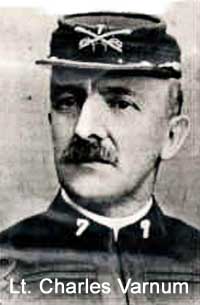
At the Battle of the Little Big Horn, Lt. Charles Varnum commanded 40-some Arikara, Crow, half-breed and white scouts -- including head scout and Arikara interpreter Mitch Bouyer , lead scouts Bloody Knife and "Lonesome" Charley Reynolds, as well as Curley, White Man Runs Him, Goes Ahead, Hairy Moccasin, Little Sioux, Red Star, Red Bear and Young Hawk.
Here is Young Hawk's account of being reunited with Varnum after Reno's retreat.
Although Varnum fails to mention it, John Ryan recalled how Varnum offered a furlough for the first Indian scalp as the Seventh Cavalry rode into battle at the Little Bighorn. Talk about being out of touch with the reality of your situation!
|
|

|